We’ve gone all electric! Our gas supply has been disconnected, the gas meter removed and the gas standing charge gone. It’s been a long journey but at last we’re at the end and have stopped all the Burning Stuff!
It was a few years ago when we trialled Project No GO and we finally have a long-term solution, only half-way through the decade. Here is how we’ve done it. You can too!
Heat Pump
The main component of this is an air-source heat pump that heats the water in the radiators and domestic hot water tank. This would have been done years earlier if it weren’t for the dated planning rules and hostile system for getting permission. I won’t go into the saga in this post but perseverance got it granted in the end.
Fortunately the rules have now changed, so you shouldn’t have to go through this. On the bright side, the government grant went up during the delay, so we actually paid less (even accounting for all of the planning fees).
We had a Daikin Altherma heat pump installed, an air-source unit rated at 11 kW (this is the heat output not the electrical consumption). It was installed by Octopus Energy Services in 4 days, which included replacing the hot water tank and swapping most of the radiators for new bigger ones.
The guys did a fantastic job and it was all very professional. I was extremely impressed with the installation team. You can get a £100 Visa cash card if you get a heat pump (or solar installation) with them via this referral link.
It’s too early to tell how the central heating really performs, although we used it a little bit earlier in the year. Ask me next year.
We now have additional cupboard space in the kitchen, where the boiler used to be. However, there is less space in the airing cupboard.
The external unit is very quiet. I’ve had multiple neighbours comment, unprompted, that it is much quieter than they thought it would be.
Local
One big reason that I prefer Daikin heat pumps is that you have local controls. The main control panel is in the airing cupboard with the hot water tank and you can control some things from the (wired) thermostat in the hall too.
Yes, it has Wi-Fi and an app, which is sometimes useful and more convenient if you are away from home, but it isn’t the only option. If my internet is down, there is a cloud service outage or my phone dies then I can still control my heating.
Not only are local controls more reliable but they are also more sustainable. You’re not using all the energy and fresh water (for cooling) required by data centres (and other communication infrastructure). If the company that made your product goes out of business or decide they don’t want to run the service any longer then your expensive hardware doesn’t become useless e-waste.
I think this is a difference between technology professionals and gadget enthusiasts. As a professional, I think about failure modes and I also have insight of typical tech internals and how the metaphorical (meat free) sausage is made. It’s not always pretty behind the curtain.
As the joke goes, the S, Q, R and A in IoT stand for security, quality, reliability and availability. Unfortunately, it’s funny because it’s true.
My home is not very “smart”. I still want my (LED) lights to work when the switch by the door turns the power on. It’s also great that friends and family can simply come round and operate the lights/heating on their own without instruction.
In Hot Water
The domestic hot water works well. I changed the settings to run only on a schedule and not reheat on-demand. This seems to be sufficient and we’ve not run out of hot water. Sometime it reports a low temperature but the sensor is pretty low in the tank and so there is more hot water left. It’s easy to boost if needed.
This schedule means that it only runs overnight during our cheap off-peak rate. Using the heat pump is more efficient than the resistive immersion heater, so the costs are even lower.
The weekly sterilisation cycle (anti-legionella) is also set to run overnight. FYI this still runs even when in holiday mode and the normal hot water is off. This gets hotter than normal, so if you don’t have thermostatic mixers (or even mixer taps) then you may need to watch out on that day. If there is a day that you typically use more hot water then you may want to align it with this.
The (bigger) radiators don’t get as hot as before so that’s less of a risk. We had previously experimented with a low flow temperature on the boiler to check it would work, using the immersion for hot water to get it hot enough to be safe.
The heat pump does weather compensation using an external temperature sensor. However, it’s too early to comment on how the heating will perform.
Cooking
Once the gas had been disconnected and capped off, I removed our gas hob and installed an induction one. Obviously, we got a proper electrician to connect it up to the consumer unit. It’s on a 32 A circuit so has plenty of power.
I got a cheap (£150 inc. VAT) unbranded one from a popular trade supplier and have been very impressed with it. It’s much easier to clean and we have more work surface space, as it’s smaller but fits in the same square hole and you can also use it as a surface. It heats up very quickly, the handles of pans don’t get hot and it has more precise heat control than gas.
It doesn’t use crude PWM like our plug-in ones. This makes it easier for our home solar battery to power it, as there is no oscillation (switching on and off) at low power levels.
We also bought an inverter microwave when the previous one broke. This is more efficient and again doesn’t use PWM at low powers like most do.
I got an electric pizza oven for my birthday. It gets super hot (outdoor only) and cooks excellent pizza in a couple of minutes. You can add wood chips for flavour (not as fuel), although this is a feature that I rarely use (I’ve only tested it out once and I’m not sure it’s worth it). The same brand also makes electric BBQs, with the same wood chip (only for flavour) tech.
The plug-in hob is still useful when camping, along with our air fryer. I made a V2L (vehicle-to-load) cable for the car so that we can run a couple of 13 A plug appliances off of it, even if we don’t have a hookup at a campsite.
Cars
As covered previously, we only have electric cars.
We’ve done around 60k miles of EV motoring, including many big trips in Europe. As far as Italy and even driving all the way to Norway (Project Go NO).
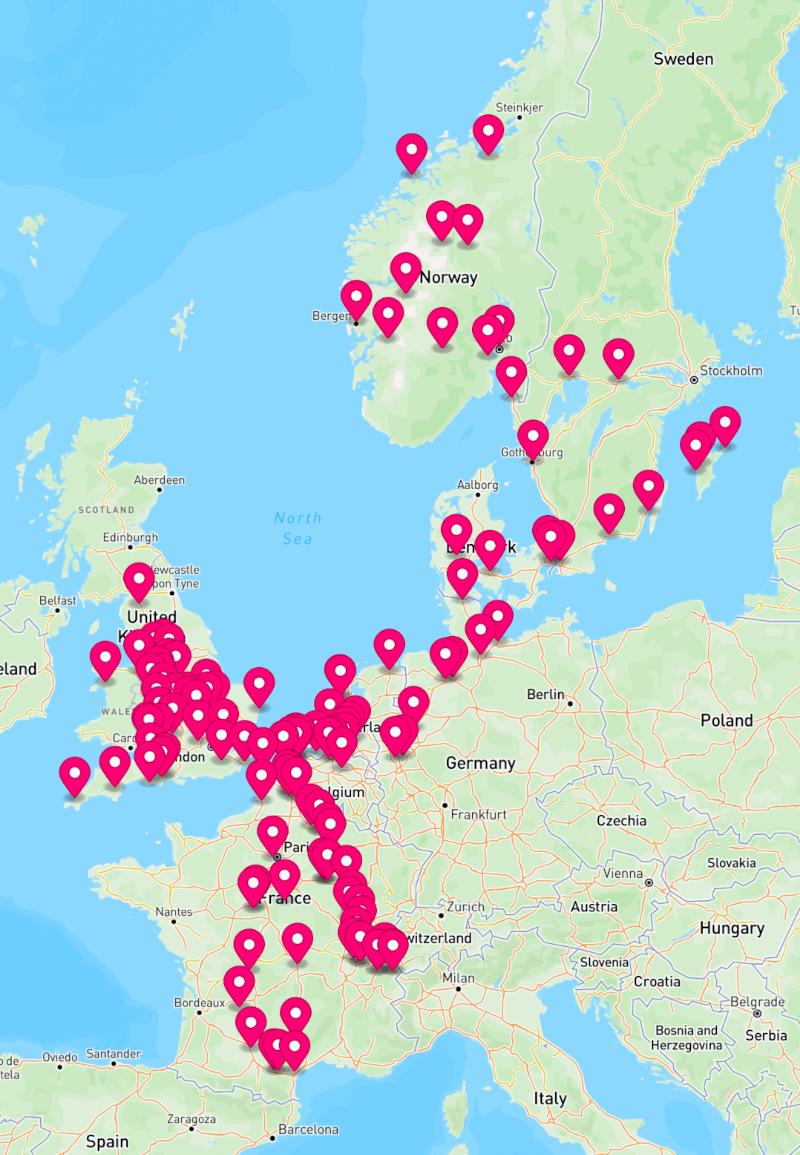
About 35k of these miles have been in Hyundai Ioniq 5s. I’ll get round to publishing a review at some point.
There have also been extended test drives including an Audi e-tron, Vauxhall Corsa and VW ID.3. This involved charging too, some of it public.
So, it’s fair to say that we know a bit about EVs and charging them. Most of the charging has been at home but we’ve also done more than 5000 kWh of public charging at over 25 different operators. That doesn’t even include where we’ve used a bank card to charge.
The Electroverse app tells me that this much public charging equates to over 1300 kg of CO2 saved. That is clearly an estimate and most of the countries we have driven to have very green electricity.
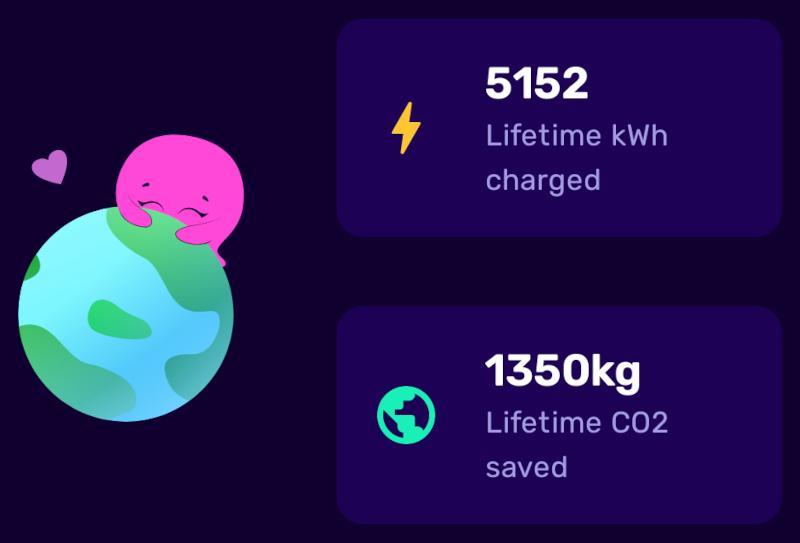
You could say we are EV connoisseurs, having unlocked all of the achievements in the Electroverse app. Charging, completed it.
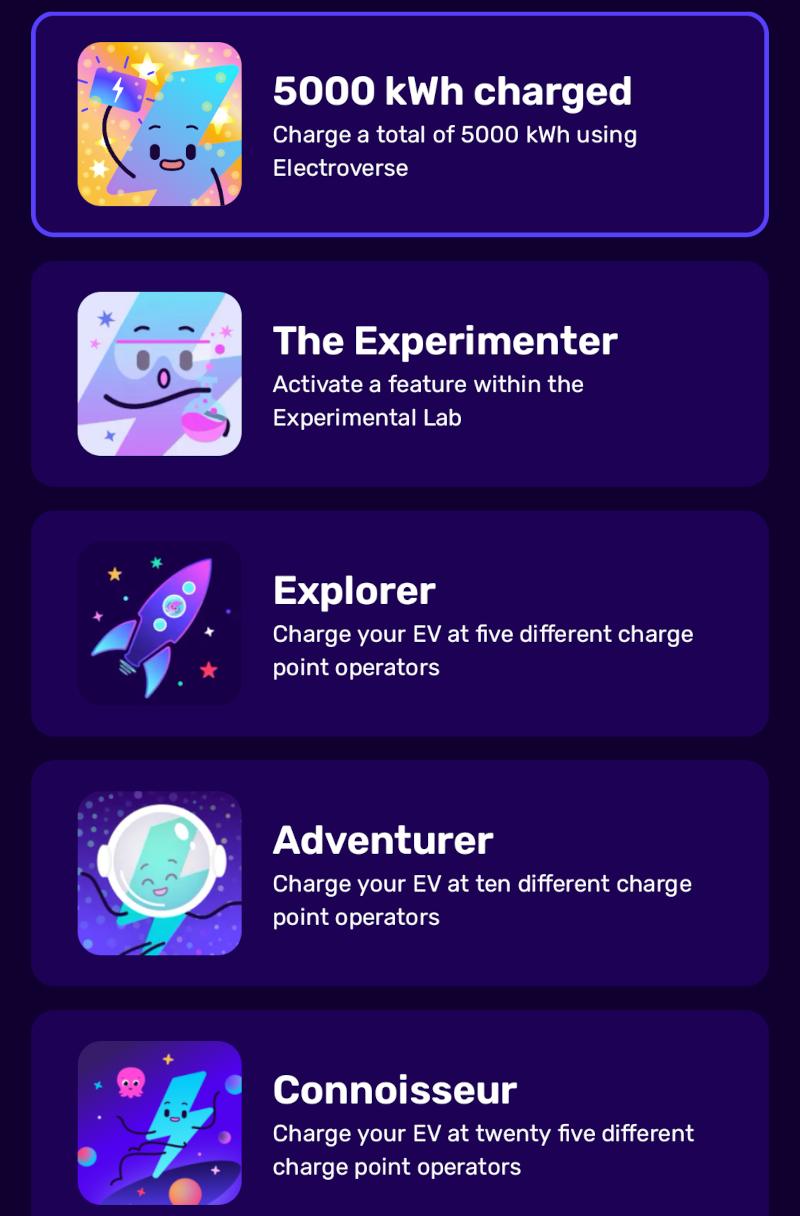
It’s definitely worth having an NFC charge-card such as Electroverse in your vehicle. I’ve had it work at chargers where bank cards were not working for others and it’s very useful for destination charging. You can get £5 of free public charging with this referral link.
If you want to know which night is greener to charge then you can use my Electric Shift web app. On the Intelligent Octopus Go tariff? If not, why not? £50 credit referral link. You can change the times to 23:30-5:30 by changing the URL to /shift/?start-hour=23&end-hour=5.
If you want to look further ahead then I also have a web app for the weekly national outlook. For this one, a higher number is greener.